

 techend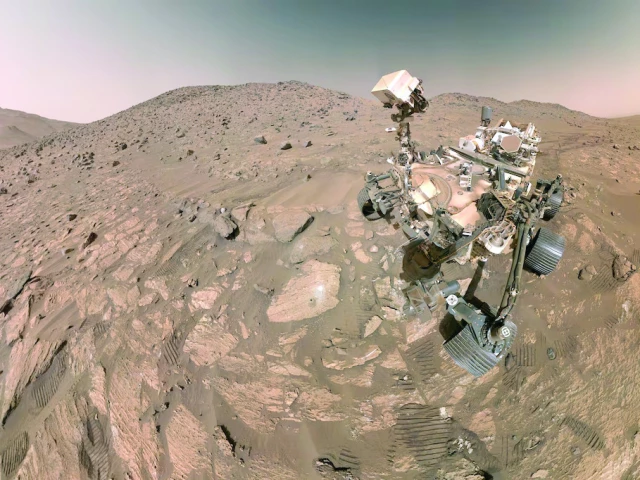
By Web Desk :
Scientists studying data from NASA’s Perseverance rover have gained new insights into organic carbon discovered on Mars, offering fresh clues about the planet’s ancient environment and its potential to have once supported life.
The latest research focuses on organic carbon molecules found in sedimentary rocks inside Jezero Crater, an area believed to have contained a lake billions of years ago. While the discovery provides important evidence that ancient Mars had chemical ingredients linked to life, researchers say it does not prove that life ever existed on the Red Planet.
The findings were published in the journal Science Advances and examine the structure of complex carbon molecules detected by Perseverance in two Martian rocks named Cheyava Falls and Walhalla Glades.
Ancient Rocks Reveal Organic Material
The rocks were collected from locations around 100 metres apart inside Jezero Crater, where Perseverance landed in 2021 as part of NASA’s mission to search for signs of ancient habitability.
Scientists believe the mudstone containing the organic material formed between 3.2 and 3.8 billion years ago, when Mars had a warmer climate and liquid water flowed on its surface.
Organic carbon is considered scientifically important because it forms the foundation of many molecules associated with life, including proteins, cells and genetic material. However, scientists stress that organic carbon can also be created through non-biological processes, meaning its presence alone cannot confirm past life.
“Organic molecules can form through biological activity, but they can also result from chemical reactions between rocks and water,” researchers said.
Possible Biosignature Under Investigation
The discovery follows NASA’s announcement last year that one of the rocks, Cheyava Falls, contained a potential biosignature — a feature that could have a biological origin but requires further analysis before scientists can draw conclusions.
Images released by NASA showed the rock containing reddish mudstone with unusual ring-shaped patterns resembling leopard spots, along with dark marks compared with poppy seeds.
On Earth, similar structures can sometimes be linked to microbial activity, but researchers say the Martian findings remain inconclusive.
Using Perseverance’s SHERLOC (Scanning Habitable Environments with Raman & Luminescence for Organics & Chemicals) instrument, scientists analysed the molecular structure of the carbon material in greater detail.
The study found that the macromolecular carbon discovered in Jezero Crater shares similarities with carbon produced through both biological and non-biological processes on Earth, as well as carbon found in some meteorites.
Mars May Once Have Had Conditions Suitable for Life
Researchers say the discovery strengthens evidence that ancient Mars had environments where life could potentially have developed.
“This indicates that the habitability of Mars and the availability of organic materials may have been widespread across the planet billions of years ago,” said planetary scientist Kyle Uckert of NASA’s Jet Propulsion Laboratory, who co-led the research.
However, Uckert stressed that the findings do not prove the existence of life and do not determine whether the carbon came from biological or geological processes.
Scientists say Perseverance’s instruments are not capable of providing the final answer. To conduct more detailed testing, the samples would need to be returned to Earth, where advanced laboratory equipment could examine them at a much higher level of sensitivity.
Mars Sample Return Could Hold the Answer
The search for ancient life on Mars remains one of the biggest goals of planetary science. NASA’s Perseverance rover has been collecting rock samples from Jezero Crater, which scientists believe was once a lake basin supplied by ancient rivers.
The samples could eventually provide researchers with direct evidence about Mars’ geological history and whether microbial life ever existed there.
Mars today is a cold and dry world, but scientists believe that during the early stages of its history, it had a thicker atmosphere, warmer temperatures and stable liquid water — conditions considered important for life.
“If life is discovered on Mars, it would suggest that life may not be unique to Earth when the right conditions and ingredients exist,” Uckert said.
For now, scientists remain cautious. The discovery represents a significant step in understanding Mars’ past, but the question of whether Earth is the only planet known to have hosted life remains unanswered.
About The Author