Germany Tests Shape-Shifting Aircraft Wings Powered by AI

By Sabeeh Zanair :

German engineers have successfully tested aircraft wings that can change shape during flight, marking a major step forward in aviation technology aimed at improving efficiency, safety and control.

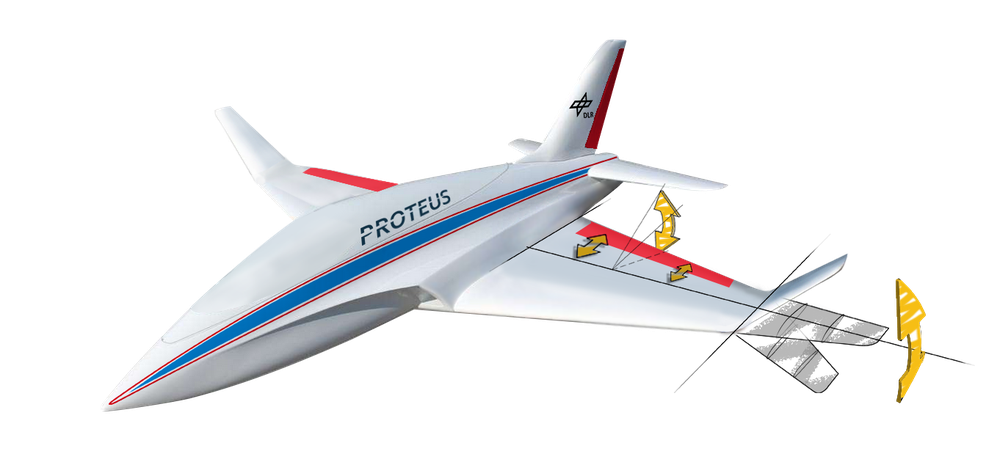
The trials were carried out by the German Aerospace Center using its experimental unmanned aircraft PROTEUS in April 2026. The research is part of the morphAIR project, which focuses on developing adaptive wing structures capable of adjusting continuously to changing flight conditions.

Scientists equipped the aircraft with both conventional wings and a new morphing design. The tests took place at the National Experimental Test Center for Unmanned Aircraft Systems in Cochstedt, where initial flights confirmed the system’s airworthiness and integration.

At the centre of the innovation is a flexible trailing edge enabled by a system known as HyTEM (Hyperelastic Trailing Edge Morphing). Unlike traditional wings that rely on rigid flaps and ailerons, this design uses multiple small actuators spread across the wingspan to smoothly alter the wing’s shape without gaps. This seamless adjustment reduces aerodynamic drag while allowing precise control of lift and flight stability.

Germany1

Project lead Martin Radestock said the morphing wings can adapt in real time to turbulence and airflow changes, helping the aircraft maintain optimal performance under varying conditions.

A key component of the system is an AI-assisted flight control mechanism developed by DLR’s Institute of Flight Systems. The adaptive software continuously monitors the aircraft’s behaviour, detects deviations from expected performance and updates its internal models during flight. This allows the system to respond instantly to disturbances and maintain stability, even in simulated failure scenarios.

Researchers also developed a method to estimate airflow pressure across the wing using only a limited number of sensors. This enables the aircraft to “sense” its aerodynamic environment and adjust accordingly in real time.

Beyond efficiency gains, the technology could significantly enhance safety. Because control functions are distributed across the wing, the system can remain operational even if some actuators fail, offering built-in fault tolerance.

Image

The concept of morphing wings dates back to early aviation, including the wing-warping techniques used by the Wright brothers. However, earlier designs were limited by structural challenges. Advances in materials, computing and artificial intelligence have now made it possible to revisit and refine the idea.

Similar research has been explored by organisations such as NASA and Massachusetts Institute of Technology, though the German approach stands out for its use of active AI control rather than passive structural adaptation.

The new technology could lead to more fuel-efficient aircraft, longer flight ranges and reduced noise levels. It is particularly promising for unmanned aerial vehicles, where flexible designs can be tested more freely without the constraints of onboard human safety.

Further flight tests are planned later in 2026 as researchers work to scale up the technology and explore its potential for wider aviation use.

About The Author

  • Related Posts

    CNN Sues Perplexity in Escalating Battle Over AI and Copyrighted Journalism

    By Malik Shahzad Aslam : CNN has launched legal action against artificial intelligence search company Perplexity, accusing the fast-growing AI startup of unlawfully using its copyrighted journalism to develop and…

    Samsung Explores Next-Generation Cooling Systems to Tackle Smartphone Heat Challenges

    By Ariz Riaz : Samsung is reportedly investigating advanced cooling technologies for future Galaxy smartphones as the company seeks to address one of the most persistent challenges facing modern mobile…

    Leave a Reply

    Your email address will not be published. Required fields are marked *

    You Missed

    CNN Sues Perplexity in Escalating Battle Over AI and Copyrighted Journalism

    CNN Sues Perplexity in Escalating Battle Over AI and Copyrighted Journalism

    Samsung Explores Next-Generation Cooling Systems to Tackle Smartphone Heat Challenges

    Samsung Explores Next-Generation Cooling Systems to Tackle Smartphone Heat Challenges

    Pakistan Finalises New E-Commerce Policy to Expand Digital Trade and Boost Exports

    Pakistan Finalises New E-Commerce Policy to Expand Digital Trade and Boost Exports

    AI Boom Faces Reality Check as Rising Costs Force Companies to Reassess Spending

    AI Boom Faces Reality Check as Rising Costs Force Companies to Reassess Spending

    Meta Eyes AI Pendant and Expanded Smart Glasses Push as Wearables Strategy Accelerates

    Meta Eyes AI Pendant and Expanded Smart Glasses Push as Wearables Strategy Accelerates

    Blue Origin Rocket Explodes During Florida Test in Major Blow to Bezos’ Space Ambitions

    Blue Origin Rocket Explodes During Florida Test in Major Blow to Bezos’ Space Ambitions