
 techend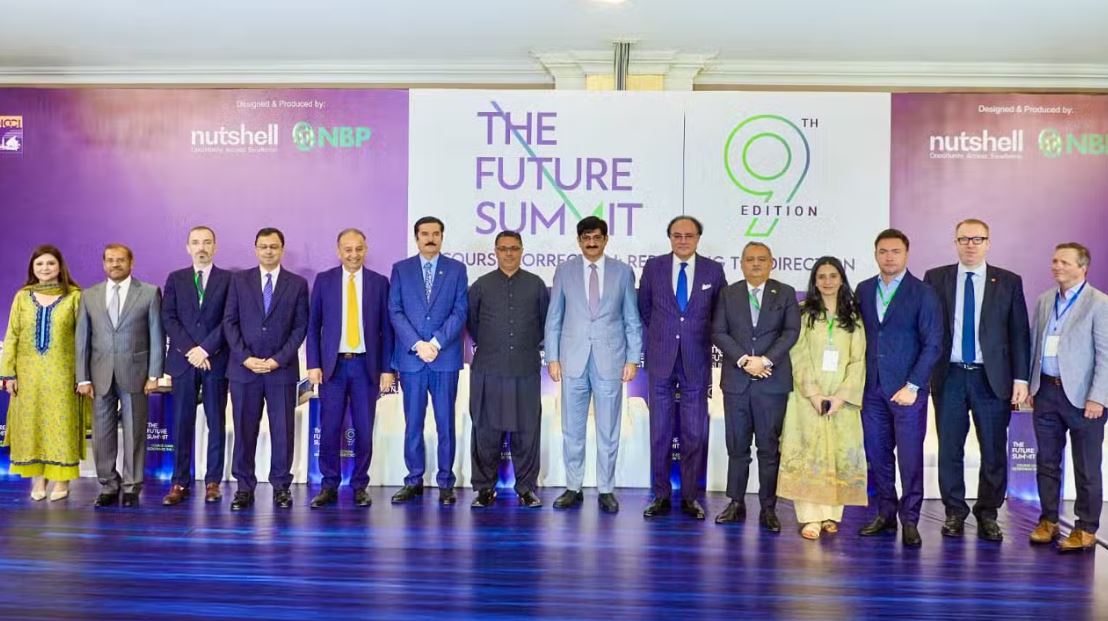
Nadeem Aslam:
Lahore:Following an impactful inaugural session with keynotes by Chief Minister Sindh, Syed Murad Ali Shah; Federal Ministers for Finance, and Climate Change; Governor KP, Faisal Karim Kundi; and corporate leadership, THE FUTURE SUMMIT (TFS) 9th Edition continued its first day with high-level strategic conversations, bringing global context and local urgency to Pakistan’s course-correction narrative.
THE FUTURE SUMMIT 9TH Edition (TFS), one of Pakistan’s premier thought leadership platforms, is co-hosted by the Nutshell Group and National Bank of Pakistan (NBP), in strategic partnership with Faysal Bank Limited and the Overseas Investors Chamber of Commerce & Industry (OICCI).
The world stands at an inflection point as climate shocks, technological upheaval, and shifting global powers demand more than adjustment; they demand course correction. The 9th Edition of TFS united leaders to confront a defining question; Are we ready to change direction before it’s too late?
The second session themed From Global Insights to Local Action opened with a strategic fire-side chat on global macroeconomic shifts, trade disruptions, and emerging market trajectories, setting the stage for Pakistan’s own repositioning efforts. Speakers included Jonathan Ashworth, Global Chief Economist, ACCA and Sajjeed Aslam, Partner & Co-Founder, Spectreco LLC, USA. Both highlighted the conflict of long-term vision with constant disruption and need to address both simultaneously.
Continuing the session, Samad Dawood, Vice Chairman, Engro Corporation; Saira Awan Malik, President, TCS Private Limited; Naz Khan, Principal Country Officer, IFC Pakistan; Muhammad Hamayun Sajjad, Chief Executive Officer, Mashreq Pakistan; Dr. Ayesha K. Khan, Regional Managing Director, Acumen; and Kabeer Naqvi, Entrepreneur in Residence, Abhi Fintech, UAE; came together for a panel discussion moderated by Assad Hameed Khan, Country Head, ACCA Pakistan.
They examined regional supply-chain realignments, the changing nature of capital flows, and the need for policy consistency to restore investor confidence. Samad expounded the need for actionable plans saying, “Countries need to spread their linkages and vary their markets both for imports and exports to counter impacts of geo-political fragmentation.” Saira regretted that there was not much scope for value added services and low margins were hindering investments in Pakistan. Defining key areas for course correction, she stated that, “Focus on infrastructure, regulatory and taxation reforms, dispute resolution mechanisms, and incentivizing female participation in workforce, are some vital corrections needed.”
The next dialogue on What’s Shaping Pakistan’s New Growth Story? saw leaders from financial services, technology, manufacturing, and insurance sectors shared perspectives on productivity, governance, and digital financial inclusion. The session panelists included Muhammad Ali Gulfaraz, Chief Executive Officer, Dubai Islamic Bank Pakistan Limited; Fatima Asad-Said, CEO, Abacus; Shoaib Javed Hussain, CEO, State Life Insurance Corporation of Pakistan; Dr. Amjad Waheed, CEO, NBP Funds; Umar Ahsan Khan, CEO, Dawlance; Farrukh H. Khan, Chief Financial Officer, Jazz; and Usman Yousuf, Director, Nutshell Group as moderator.
Umar spoke on the essence of the depth of Pakistan’s market and potential for upscaling given stable policy framework. “Pakistan only has one effective Free Trade Agreement (FTA). We need to focus on such agreements to increase export trade volume,” he said. Commenting on use of technology, Fatima said, “AI should be intelligently used to augment data driven decision making led growth as well as positively impact the customer experience.” “Developing countries have the freedom to start from the scratch and bypass legacy system to get a jumpstart on new technology,” Farrukh added.
Muhammad Ali Gulfaraz observed, “MENA is more relevant to Pakistan today than western institutions and is ready to take risks in the Pakistani market.” All speakers underscored the importance of private-sector leadership, rational use of technology, prioritizing areas of short-term and long-term growth and investment in relevant areas to unlock Pakistan’s demographic dividend and strengthen global competitiveness.
About The Author