
 techend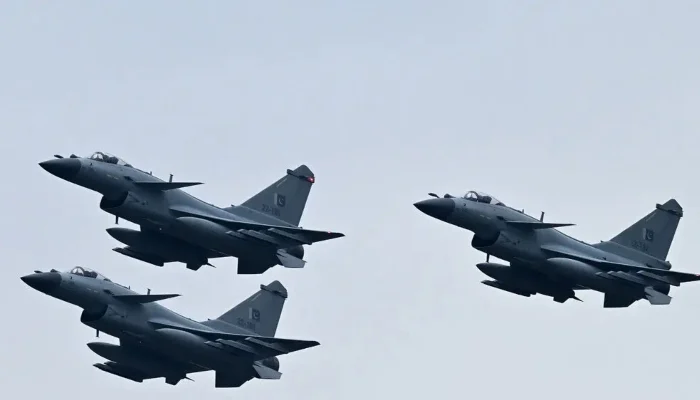
By Tanveer Ahmed :
Pakistan has marked the first anniversary of last year’s brief but intense military confrontation with India, describing it as “Marka-e-Haq” and portraying it as a turning point in regional air warfare and modern combat doctrine.
The conflict, which both sides link to the aftermath of the April 2025 Pahalgam attack, escalated rapidly in early May when India launched air and missile strikes across the border. Pakistan responded with its own military operation, leading to a 96-hour period of sustained aerial and cross-domain engagement between the two nuclear-armed neighbours.
In Pakistan’s official narrative, the episode has been framed as a decisive demonstration of operational readiness and technological integration by the armed forces, particularly the Pakistan Air Force (PAF), which has described the outcome as evidence of “air superiority” during the confrontation.
Indian officials have previously referred to their initial strikes as part of “Operation Sindoor”, while Pakistan named its response “Operation Bunyan-um-Marsoos”. Independent verification of many battlefield claims made by both sides remains limited, as is typical in high-intensity cross-border conflicts involving restricted military disclosures.
At the centre of Pakistan’s account is the claim that the PAF effectively neutralised a numerically larger Indian Air Force (IAF) through a combination of modern fighter aircraft, networked command systems and long-range missile capability.
The confrontation reportedly involved a wide range of aircraft on both sides, including India’s Rafale jets, Su-30MKIs and MiG-29s, alongside Pakistan’s J-10C and JF-17 Thunder Block III fleets. Military analysts note that such mixed-force engagements increasingly reflect the complexity of modern aerial warfare, where sensors, data links and electronic warfare can be as decisive as aircraft performance itself.
Pakistan has highlighted the role of its J-10C fighter jets as a key element in its operational posture. The aircraft is equipped with modern radar systems and is designed for networked combat operations. Pakistani officials have also emphasised the integration of airborne early warning systems, which they say enabled real-time battlefield awareness and coordinated targeting.
In this context, platforms such as the Saab 2000 Erieye airborne warning and control system are often cited in Pakistan’s defence doctrine as critical force multipliers. These systems allow air forces to detect and track aerial activity over long distances, feeding data to fighter jets and missile units.
The aerial confrontation is also said to have involved beyond-visual-range missile engagements, a domain that has increasingly defined modern air combat. Pakistan has highlighted the role of the PL-15 air-to-air missile, while India operates the European Meteor missile system on its Rafale fleet.
Defence analysts note that both systems are among the most advanced long-range missiles currently in service globally, designed to engage targets well beyond visual range using active radar guidance and high-speed propulsion technologies.
Pakistan has also emphasised the concept of a “network-centric kill chain” in its military doctrine, referring to the integration of sensors, command systems and strike platforms into a unified operational structure. In such systems, data from airborne and ground-based radars is fused to provide pilots with a shared operational picture.
Military observers say this approach reflects a broader global trend in modern warfare, where connectivity and information dominance are increasingly central to combat effectiveness.
During commemorative statements, Pakistan’s military leadership has also reiterated claims regarding the performance of indigenous and imported systems across air, land and electronic warfare domains. These include drones, air defence systems and long-range strike capabilities.
India, for its part, has not publicly confirmed the scale of losses claimed by Pakistan during the confrontation, and official statements have largely focused on its own operational objectives during the period.
The confrontation also saw extensive use of electronic warfare and air defence systems by both sides, underscoring the growing importance of detection, jamming resistance and missile interception in modern aerial conflicts.
While Pakistan has portrayed the episode as a validation of its evolving military strategy and technological modernisation, independent military analysts continue to caution that battlefield narratives in such conflicts are often contested and shaped by strategic communication as much as by operational reality.
What remains clear, however, is that the brief but high-intensity clash has intensified interest among global defence observers in South Asia’s evolving air power balance and the increasing role of integrated, network-driven warfare in future conflicts.
About The Author