

 techend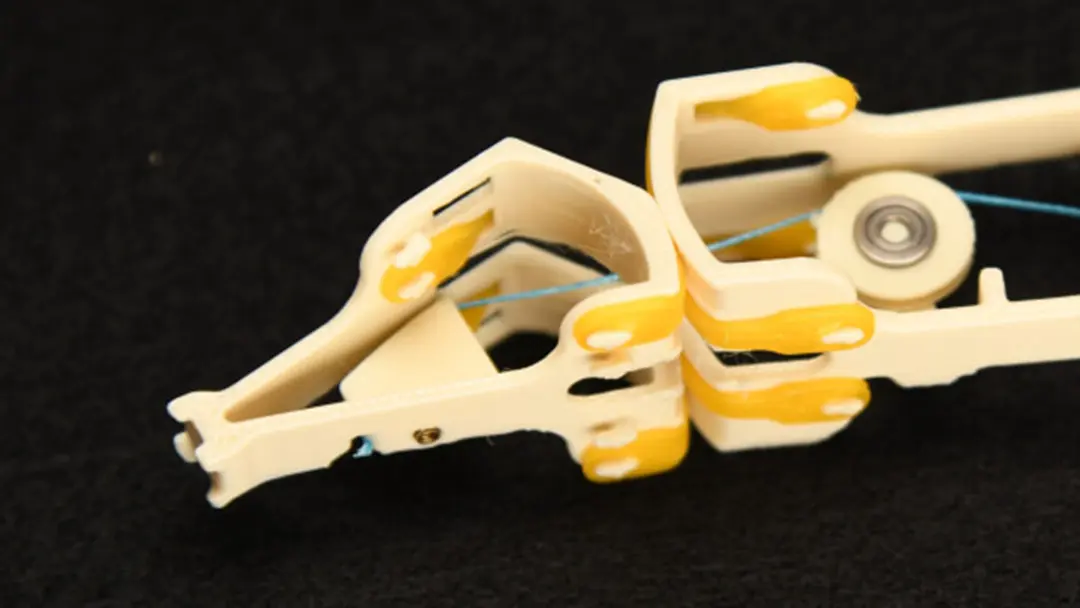
By Ariz Riaz :
Researchers at Harvard University have developed a new robotics technology that emulates the rolling motion of human joints, potentially enabling robots to move more smoothly, safely, and efficiently than conventional designs. This “rolling joint” mechanism could improve mobility in applications ranging from prosthetic devices to highly agile robots.
Traditional robotic joints typically function like hinges or sliders, constrained to fixed axes with motors and gears. While sufficient for many industrial tasks, these rigid designs limit adaptability and natural movement, particularly in human-centric environments. Inspired by biomechanics, the new rolling joint allows continuous contact between surfaces, producing smoother transitions between angles and more even distribution of forces.
“Whenever you have a robot and a task in mind — for example, a walking robot — you can start considering the optimal points to apply force,” said Colter Decker, a Ph.D. student at SEAS and the study’s first author.
The rolling joint replaces fixed pivot points with surfaces that roll against one another, similar to how a wheel rolls instead of sliding. This reduces friction, spreads stress more evenly, and allows greater movement flexibility without relying on complex control algorithms.
Prototype robots equipped with rolling joints demonstrated improved dexterity, managing tasks such as climbing uneven terrain, autonomously adjusting posture, and stabilizing in response to disturbances. The design also consumes less energy compared with traditional actuators, making it highly efficient.
“Our goal is to transfer as much motion control as possible to the robot’s mechanical design and materials, allowing the control system to focus on higher-level tasks,” said Robert J. Wood, senior author of the study. “Colter’s approach achieves this elegantly, both mechanically and mathematically.”
The concept originated from efforts to enhance soft robotic grippers, which need to gently envelop objects while applying sufficient force. The team explored combining rigid links with flexible joints, designing rolling contact joints that replicate the function of bones and cartilage in human limbs.
Experts note that this approach represents a shift from viewing robots as rigid machines toward creating systems that integrate more naturally into human environments. In areas such as elder care, physical therapy, and collaborative automation, the ability to move with finesse can significantly improve safety and usability.
Although still in the research stage, Harvard’s rolling joint design points to a future where robots are not only stronger or faster, but also more adaptable and safer when interacting with people.
About The Author