
 techend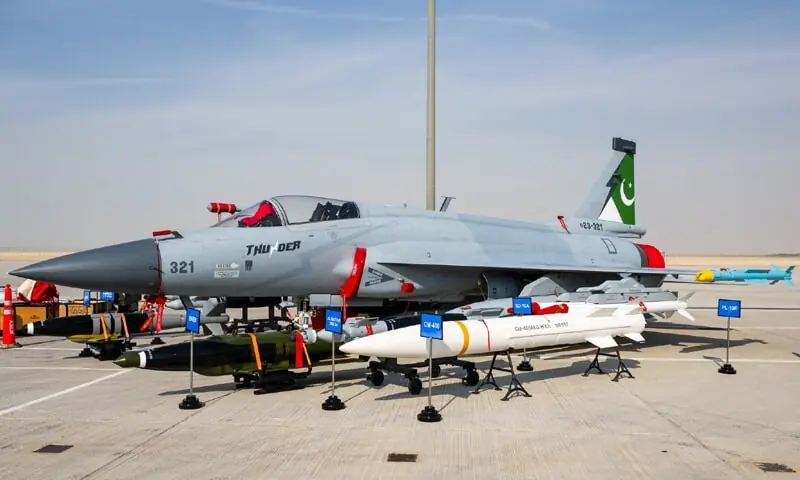
By Malik Shahzad Aslam :
Pakistan’s defense manufacturing sector has entered a high-growth phase as the JF-17 Thunder Block III transitions from a cost-effective alternative to a combat-proven multirole fighter. Following its deployment in the May 2025 conflict with India, where Pakistani officials claim the jet demonstrated superior operational efficacy, international interest has reached an all-time high.
Prime Minister Shehbaz Sharif, during a federal cabinet meeting on January 14, 2026, confirmed that several countries are “actively engaged” in procurement talks, a move expected to significantly bolster Pakistan’s foreign exchange reserves and industrial standing.
The Block III Advantage: Closing the Tech Gap
The latest Block III variant represents a generational leap over its predecessors, positioning itself within the 4.5-generation category. Key technical upgrades showcased at recent international forums include:
-
Active Electronically Scanned Array (AESA): The KLJ-7A radar provides advanced target tracking and electronic counter-countermeasures.
-
Superior Armament: Integration of the long-range PL-15E air-to-air missile, which offers beyond-visual-range (BVR) capabilities comparable to high-end Western platforms.
-
Operational Flexibility: Improved avionics, helmet-mounted displays, and an infrared search-and-track (IRST) system.
Strategic Export Pipeline: 2026 Projections
Analysts at KTrade and international defense monitors suggest that the current pipeline of deals could generate up to $13 billion, potentially increasing Pakistan’s foreign reserves by nearly 82%.
The “SIFC” Factor and Production Scalability
The Special Investment Facilitation Council (SIFC) has identified defense production as a “single-window” priority for foreign investment. To meet this surging global demand, the Pakistan Aeronautical Complex (PAC) Kamra is reportedly planning to double its annual production rate—currently at 20–25 aircraft—by late 2027.
However, industry experts maintain a cautious outlook. Defense Production Minister Raza Hayat Harraj noted that while interest is high, “negotiations can fall through due to international pressures.” Success remains contingent on maintaining stable supply chains for engines (Russian RD-93 or Chinese WS-13) and navigating the complex geopolitics of dual-use technology with Beijing.
As the 27th ITCN Asia and recent defense dialogues in Rawalpindi demonstrate, Pakistan is aggressively repositioning itself not just as a consumer, but as a reliable, flexible provider of “combat-tested” defense capacity for the Global South.
About The Author